
If you’ve been saving pictures of clean-lined bands and tiny compass symbols, wondering whether this is finally the spot for your next piece, you’re not alone. The search for the perfect wrist tattoo men choose today has grown rapidly, with this placement becoming one of the most popular options for those who want meaningful yet manageable ink. It’s small but noticeable, personal without shouting for attention, and easy to hide under a sleeve or watch when you need to.
This guide covers the best design directions, where exactly on the wrist to place your ink, how much it hurts, how long it takes to heal, and what to think about if your job isn’t exactly tattoo-friendly.
Why This Placement Works So Well for Men
A wrist tattoo sits in a sweet spot between visible and private. It’s public enough that people notice it during a handshake, yet a long sleeve or bracelet covers it in seconds when needed. That flexibility makes it a favorite first-tattoo choice — the size stays manageable, the cost is reasonable, and it gives you a low-stakes way to test how you feel about permanent ink before going bigger elsewhere.
Understanding Wrist Placement Options
Inner Wrist: The softer, paler side facing your palm. Great for private, meaningful designs like initials or a single word, though thinner skin here means more sensitivity and faster fading on detailed pieces.
Outer Wrist: Faces outward, right where a watch sits. More padding makes it slightly easier to tolerate, and it holds detail better over time — ideal for bolder, more visible designs.
Wrap-Around (Bracelet/Cuff Style): The design circles the entire wrist like a permanent accessory. Bold black bands, chain-link patterns, or geometric repeats fall here. It needs careful planning so the design lines up correctly, but it’s one of the most striking looks available.
Best Wrist Tattoo Men Ideas for Every Style
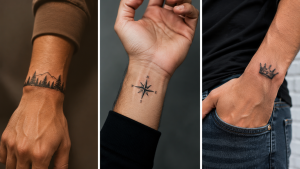
Look below for some of the most stylish wrist tattoo men ideas, from simple and minimal designs to bold artwork that makes a statement.
1. Minimalist and geometric designs
Single-line mountains, tiny arrows, triangles, or a simple dot pattern. Clean, quick to sit through, and they age well since there’s barely any fine detail to blur over time. Because the lines are so simple, the session itself is usually short, which makes this a low-commitment way to test the placement. It’s also the easiest style to scale up or down depending on how much of the wrist you want to use.
2. Bracelet or band tattoos
Bold black lines, tribal-inspired patterns, or a design mimicking beads and leather straps. Practically a permanent accessory you never have to remember to put on. Some men mix in small gaps or varying line thickness to give the band more texture instead of one flat block of ink. It pairs well with a watch too, since the two sit right next to each other without competing for attention.
3. Compass and directional symbols
A go-to for men who want something tied to purpose, ambition, or a specific journey they’ve been on. The compass works well both as a standalone piece and combined with a small arrow or coordinates for extra meaning. It’s also flexible in size, so it can sit small and subtle or slightly larger with more detailed needlework inside the dial.
4. Roman numerals and coordinates
Popular for marking an important date, a birthplace, or the location of a life-changing moment. Numerals tend to read cleanly in a straight line along the wrist, which keeps the design tidy even on a narrow strip of skin. Coordinates work the same way, though they usually need a slightly steadier hand from your artist since the numbers are small and close together.
5. Short words and phrases
“Carpe Diem,” a single mantra, or initials of someone who matters. Small enough to fit cleanly without crowding the space. Font choice matters more than people expect here — a simple serif or handwritten script tends to hold up better over the years than anything too thin or overly stylized. Keep it to one word or a short phrase; anything longer starts fighting for room.
6. Zodiac and astronomical symbols
Crescent moons, small star clusters, or a zodiac glyph — personal without needing an explanation every time someone asks. These designs work well paired with a thin line or a single star to fill extra space without overcrowding the wrist. They also age nicely since the shapes are simple and don’t rely on heavy shading to look complete.
7. Nature-inspired art
Mountain silhouettes, wave outlines, bare tree branches, sunflowers. Often tied to a hometown, a hike, or a reminder of resilience. These pieces read well in both fine-line black ink and a soft single-color wash if you want a touch more depth. Many men place them running along the wrist horizontally so the silhouette actually looks like a skyline or a horizon.
8. Spiritual and cultural motifs
Mandalas, om symbols, or tribal patterns rooted in heritage. Worth researching properly so the design stays accurate and respectful. Mandalas in particular translate well to a circular wrap-style layout, while om symbols and smaller glyphs sit comfortably as a single centered piece. Take time picking an artist who has actual experience with the specific tradition you’re drawing from.
9. Animal and bold statement pieces
A skull, a lion’s face, or detailed linework — scaled down and simplified to fit the smaller canvas without losing impact. These designs need a slightly more skilled hand since fine facial detail has to hold up despite the limited space. Expect your artist to simplify shading or drop some detail so the piece doesn’t blur into a smudge within a few years.
10. Watch-style or single-line wrap designs
A thin continuous line circling the wrist, sometimes broken by a small symbol, for guys who want subtlety with a bit of edge. It mimics the placement of a watch strap without any of the bulk, which makes it a good option for men who already wear one daily. A small gap or single accent symbol along the line keeps it from looking like a plain, uneventful ring of ink.
Choosing the Right Design for Your Life
A few things worth weighing before you settle on a design:
- Your career: Casual or creative jobs allow bolder, outer-wrist visibility. Corporate roles often call for smaller, easily concealed inner-wrist designs. Not sure which bucket your workplace falls into? Watch how coworkers with visible ink get treated before committing to something loud.
- Your wrist size: Slimmer wrists suit delicate line work. Broader builds need slightly larger pieces so the design doesn’t get lost. Most single-symbol designs land best between one and two inches.
- Your daily habits: Typing all day, lifting weights, or working with your hands means more flex and stretch on the skin than a quieter routine. Simple shapes hold up better than fine, delicate detail under that kind of movement.
- Your existing ink: A wrist piece doesn’t have to match a sleeve or another tattoo, but keeping a similar line weight or color palette makes everything look intentional. First tattoo? Don’t overthink it — pick what feels right now.
- The long game: Trends fade, but a wrist tattoo doesn’t. A design tied to a belief, a memory, or a shape you’ll still like a decade from now ages a lot better than something copied from a feed.
Is a Wrist Tattoo Right for a Professional Setting?
- Corporate environments: Favor the inner wrist. Cover it easily, keep the symbol small, and it barely registers during a handshake or presentation.
- Creative and casual industries: Go outer wrist. It sits right where people naturally look anyway.
- Want something safe no matter where you work? Geometric minimalism in black ink, kept under two inches, reads as deliberate rather than impulsive — a design that works in a boardroom and a bar equally well.
Does a Wrist Tattoo Hurt?
Yes. More than most spots on the body.
Why it hurts more:
- Thin skin
- Close proximity to bone
- A dense cluster of nerve endings right under the surface
That combination pushes the wrist toward the higher end of the pain scale — most people land somewhere around a 5 to 7 out of 10, though pain tolerance is genuinely personal. And between the two spots, the inner wrist hurts more than the outer wrist. Simple as that.
A few things that help take the edge off:
- Eat a proper meal before your appointment
- Sleep well the night before
- Stay hydrated
- Ask your artist about numbing cream in advance — not every studio allows it mid-session
Healing and Aftercare
Timeline:
- Surface healing: 2 to 4 weeks
- Full healing underneath: 6 to 8 weeks
- Don’t judge the tattoo by how it looks on day ten
Aftercare basics:
- Clean it with mild, fragrance-free soap
- Moisturize once it starts feeling tight or dry
- Skip long soaks in water — showers are fine, baths and pools aren’t, not until it’s fully closed over
- Cover it or use sunscreen once your skin can tolerate it; sun exposure fades fresh ink fast
- Keep watches and bracelets off longer than you’d expect — constant rubbing slows healing and irritates the area
What’s normal vs. what’s not:
- Normal: some swelling and itching in the first few days
- Not normal: excessive redness, warmth, or discharge — worth a call to your artist or a doctor
Because the wrist moves nonstop through typing, driving, and daily life, fading happens a bit faster here than on quieter parts of the body. A touch-up every few years isn’t a failure — it’s just wrist tattoo maintenance.
Things to Consider Before You Book
Before finalizing your wrist tattoo men idea, take time to do the following
- Find the right artist: Someone who’s actually worked on wrists before, not just someone whose portfolio looks good in general. Thin skin leaves very little margin for error, and shaky linework here can blur or “blow out” faster than almost anywhere else.
- Budget realistically: A small minimalist symbol costs less than a full wrap-around bracelet design, both because of time and the precision needed to keep everything aligned as it circles the arm.
- Remember it’s permanent: Paying for skill over a bargain price is worth it every time.
Wrapping Up
The popularity of wrist tattoos for men today reflects a shift toward smaller, more personal ink rather than large statement pieces. Quiet on the inner wrist, bold on the outer wrist, or wrapped entirely around like a permanent accessory, this placement can adapt to whatever style you want. Expect some level of pain, commit to proper aftercare, and find an artist who genuinely understands this part of the body, not just tattooing in general. Sketch your idea, give it some time, and then book a consultation. One conversation with the right artist can tell you more about whether the design suits you than endless hours of scrolling through inspiration photos.
FAQs
Q1. Do wrist tattoos hurt more than other placements?
Yes, generally. Thin skin and closeness to bone make this spot more sensitive than fleshier areas like the arm or thigh.
Q2. How long does healing take?
Surface healing takes two to four weeks. Full healing underneath can stretch to six or eight weeks.
Q3. Best design for a professional job?
Simple geometric shapes or small symbols in black ink, placed on the inner wrist for easy concealment.
Q4. Inner or outer wrist — which is better?
Inner wrist is more private but more painful and fades faster. Outer wrist is more visible, slightly less painful, and holds detail longer.
Q5. Does numbing cream help?
Yes, though confirm with your artist beforehand — not every studio allows it.
Q6. Do wrist tattoos fade faster than others?
Often, yes, thanks to constant movement and friction from daily activities.
Q7. Good choice for a first tattoo?
Absolutely. Manageable size, reasonable cost, and a solid test run before committing to something bigger elsewhere.